
By Mamta Sharma, Advocate on Record, Supreme Court of India
POSTED IN ARBITRATION, DISPUTE RESOLUTION
Gujarat Water Supply and Sewerage Board v. Saryu Plastics Pvt. Ltd.
2026 INSC 552 | Civil Appeal Nos. 769–770 of 2026 | Decided: 26.05.2026
Bench: Hon’ble Mr. Justice Pamidighantam Sri Narasimha & Hon’ble Mr. Justice Alok Aradhe
The Supreme Court of India, in Gujarat Water Supply and Sewerage Board v. Saryu Plastics Pvt. Ltd. [2026 INSC 552], decided on 26.05.2026, has laid down important propositions of law on four distinct issues arising under the Arbitration and Conciliation Act, 1996 (“the Act”). The judgment merits careful attention by all practitioners engaged in arbitral proceedings.
BRIEF FACTS
Disputes arose between the parties in relation to supply contracts for PVC pipes executed during 1998–2002. The parties entered into an Arbitration Agreement on 03.04.2012, under which the mandate of the Sole Arbitrator was stipulated to be six months. The arbitral proceedings, however, extended over approximately three and a half years — owing primarily to the repeated defaults, non-compliance with procedural directions, and unjustified non-attendance of the Appellant-Board. The Arbitral Award was passed on 27.10.2015, partly allowing the Claimant’s claim. The Award was challenged by the Board under Section 34 of the Act. The Commercial Court dismissed the challenge. The Board preferred an appeal before the High Court of Gujarat, which was also dismissed. The present appeals arose therefrom.
ISSUE I — VALIDITY OF THE ARBITRAL MANDATE
The contractual mandate of the Arbitrator expired on 18.10.2012 and was extended by consent of both parties until 30.09.2014. Beyond that date, the Arbitrator extended his mandate unilaterally on three occasions. The Board raised no contemporaneous objection. Its objection was raised only on 28.10.2015 — one day after the Award had already been passed and dispatched.
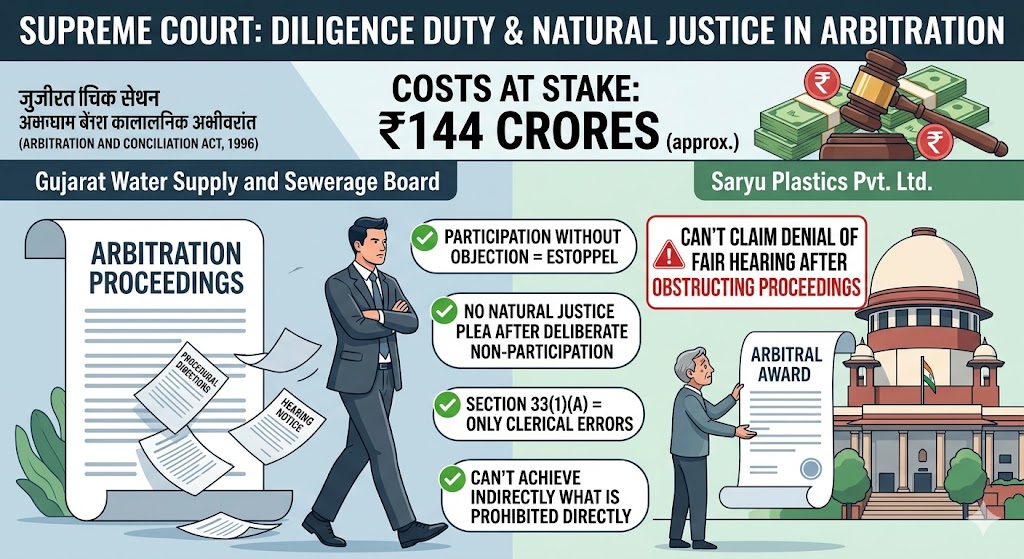
The Court held that, in the absence of a statutory provision prescribing a mandatory form for extension of mandate, the Board’s conduct amounted to tacit consent. Having participated in the arbitral proceedings without raising any contemporaneous objection to the expiry of mandate, the Board was estopped from challenging the Award on that ground.
The Court further observed that Section 29A of the Act — which now prescribes statutory timelines for the delivery of an Award — was not applicable on the facts of the present case, as the Award was passed prior to its retrospective amendment of 23.10.2015.
The decision in Bharat Udyog Ltd. v. Ambernath Municipal Council [(2026) SCC OnLine SC 463] was distinguished. The Court clarified that waiver and estoppel operate against contractual rights — not against statutory prohibitions. Where the mandate is governed by contract and not by statute, estoppel applies with full force.
ISSUE II — DATE OF DISPATCH OF THE AWARD
The Board contended that the Award was dispatched on 29.10.2015, after its email of 28.10.2015. The courier receipt produced before the Court established that the Award had been dispatched on 27.10.2015 — two days prior to the Board’s communication. This issue was accordingly answered in the negative.
ISSUE III — PRINCIPLES OF NATURAL JUSTICE
The Board was afforded repeated opportunity to participate in the arbitral proceedings across three and a half years. It failed to file point-wise replies to the Statement of Claim, failed to attend scheduled hearings on multiple occasions, and even declined to appear at the hearing fixed specifically at its own request on 15.10.2015 — without seeking any adjournment or proposing an alternative date
|
|
“The Board’s failure to avail itself of these opportunities in a timely and effective manner cannot now be converted into a grievance about denial of natural justice.” — Supreme Court of India, 2026 INSC 552 |
The right to be heard is a right that must be exercised with diligence and good faith. A party that obstructs the progress of arbitral proceedings cannot, after an adverse Award, seek to invoke the principles of natural justice to impugn it. The Arbitrator was fully justified in treating the matter as heard and proceeding to pass the Award.
ISSUE IV — JURISDICTION UNDER SECTION 33(1)(A) OF THE ACT
|
Financial Impact: The Commercial Court’s modification of the Award caused the Board’s liability to escalate from ₹30.38 crores to ₹144.93 crores — an increase of over ₹114 crores — by substituting “simple interest” with “compound interest” for the pendente lite period. |
The original Award granted simple interest at 21.675% per annum for the pendente lite period and compound interest from the date of the Award till realisation. The Company filed an application under Section 33 of the Act seeking correction of the Award by substituting “simple interest” with “compound interest”. The Commercial Court, purporting to exercise review jurisdiction, allowed the application. The Supreme Court set aside this order.
Relying upon the decisions of this Court in:
◆ State of Arunachal Pradesh v. Damani Construction Co., (2007) 10 SCC 742 — which held that Section 33 does not contemplate a review of the Award; and
◆ Gyan Prakash Arya v. Titan Industries Ltd., (2023) 1 SCC 153 — which reiterated that the power under Section 33 extends only to arithmetical or clerical errors and does not permit any material change to the Award
the Court held that Section 33(1)(a) of the Act is confined to the correction of computational, clerical, or typographical errors. It does not confer power to review or revise the substantive findings of the Award. The determination of the mode of interest — whether simple or compound — is a deliberate exercise of judicial discretion on the merits. It is not a clerical or typographical error. A Court exercising review jurisdiction cannot achieve, indirectly, what it is expressly prohibited from doing directly under Section 34 of the Act.
KEY LEGAL PROPOSITIONS
1. A party that participates in arbitral proceedings without raising a contemporaneous objection to the expiry of the Arbitrator’s mandate is estopped from challenging the Award on that ground at a later stage.
2. Waiver and estoppel operate against contractual rights. They do not operate against a statutory prohibition. See Bharat Udyog Ltd. v. Ambernath Municipal Council (2026) as distinguished from the present case.
3. Section 29A of the Act prescribes statutory timelines for delivery of Awards. Its non-applicability here was on account of the pre-amendment factual matrix — practitioners must note that post-amendment proceedings are governed by a different regime.
4. The right to be heard under the principles of natural justice imposes a corresponding duty of diligence on the party asserting it. Deliberate non-participation does not constitute a denial of natural justice.
5. Section 33(1)(a) of the Act permits correction of arithmetical, clerical, and typographical errors only. It does not permit substantive modification of an Award, including alteration of the nature or mode of interest. See: Damani Construction (2007); Gyan Prakash Arya (2023).
6. A Court cannot achieve through review under Section 33 what it is expressly prohibited from doing under Section 34. The scheme of the Act is one of minimal judicial intervention in the merits of an Arbitral Award.
REFERENCES
A. Cases Decided and Cited
1. Gujarat Water Supply and Sewerage Board v. Saryu Plastics Pvt. Ltd. 2026 INSC 552 | Civil Appeal Nos. 769–770 of 2026 | Supreme Court of India | 26.05.2026
2. Bharat Udyog Ltd. v. Ambernath Municipal Council through Commissioner and Anr. (2026) SCC OnLine SC 463 | Supreme Court of India
3. Gyan Prakash Arya v. Titan Industries Ltd. (2023) 1 SCC 153 | Supreme Court of India
4. State of Arunachal Pradesh v. Damani Construction Co. (2007) 10 SCC 742 | Supreme Court of India | 28.02.2007
5. C. Velusamy v. K. Indhera 2026 SCC OnLine SC 142 | Supreme Court of India
6. NBCC Limited v. J.G. Engineering Pvt. Ltd. (2010) 2 SCC 385 | Supreme Court of India
7. Jayesh H. Pandya and Anr. v. Subhtex India Limited and Ors. (2020) 17 SCC 383 | Supreme Court of India
8. Gayatri Balasamy v. ISG Novasoft Technologies Ltd. (2025) 7 SCC 1 | Supreme Court of India
B. Statutory Provisions
1. Arbitration and Conciliation Act, 1996 (Act No. 26 of 1996)
2. Section 14 — Failure or impossibility to act; termination of mandate
3. Section 29A — Time limit for arbitral award
4. Section 33 — Correction and interpretation of award; additional award
5. Section 33(1)(a) — Correction of computational, clerical and typographical errors
6. Section 34 — Application for setting aside arbitral award
This commentary is prepared for informational and professional purposes only and does not constitute legal advice. All statutory provisions and citations should be verified independently.