
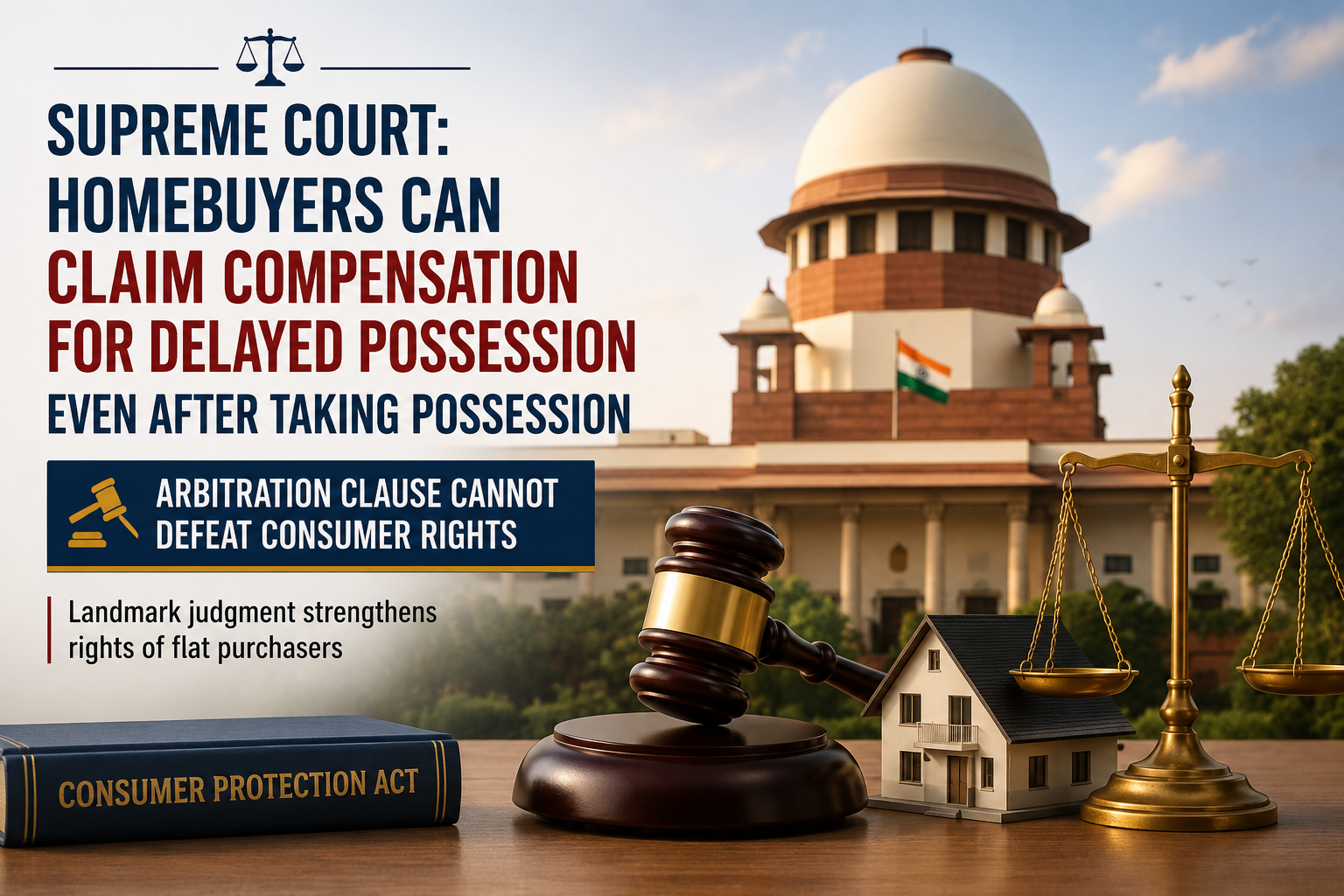
Delayed possession has long been one of the biggest problems faced by homebuyers. Builders and housing societies often argue that once a purchaser accepts possession of the flat, the dispute comes to an end and no further compensation can be claimed.
The Supreme Court has now made it clear that this argument does not hold good in law.
In a significant judgment delivered on 4 June 2026, a Bench of Justice Vikram Nath and Justice V. Mohana held that a homebuyer does not forfeit the right to claim compensation merely because possession of the property has been taken. The Court also reaffirmed that an arbitration clause in the agreement cannot prevent a consumer from approaching the Consumer Commission.
The decision is likely to have a significant impact on housing disputes across the country, particularly in cases involving delayed possession.
Background of the Case
The appellant became a member of a cooperative group housing society in 2003 and was allotted a flat under an agreement executed in February 2004.
Alleging an unreasonable delay in receiving possession, he approached the District Consumer Forum in 2005 seeking compensation for the delay.
Instead of contesting the complaint on its merits, the housing society relied upon the arbitration clause contained in the agreement and requested that the dispute be referred to arbitration under Section 8 of the Arbitration and Conciliation Act, 1996.
The District Forum ultimately accepted that request. The State Commission and the National Consumer Disputes Redressal Commission (NCDRC) also upheld the decision.
The NCDRC went a step further and observed that since the allottee had already taken possession of the flat, he could no longer be treated as a “consumer” entitled to maintain a complaint.
The matter eventually reached the Supreme Court.
Two Important Questions Before the Court
The Supreme Court examined two important legal questions:
- Can a Consumer Commission refuse to hear a complaint simply because the agreement contains an arbitration clause?
- Does a homebuyer lose the right to seek compensation after accepting possession of the flat?
The Court answered both questions in favour of the homebuyer.
Arbitration Cannot Replace Consumer Remedies
The Court reiterated that the Consumer Protection Act is a beneficial legislation enacted to provide consumers with a simple, speedy and inexpensive remedy against deficiency in service.
Referring to Section 3 of the Consumer Protection Act, 1986, the Court observed that the remedies available under the Act are “in addition to and not in derogation of” other legal remedies. In other words, the existence of another remedy—including arbitration—does not take away the jurisdiction of Consumer Commissions.
The Bench relied upon earlier Supreme Court decisions such as Fair Air Engineers Pvt. Ltd. v. N.K. Modi, Secretary, Thirumurugan Cooperative Agricultural Credit Society v. M. Lalitha, National Seeds Corporation Ltd. v. M. Madhusudhan Reddy, and Emaar MGF Land Ltd. v. Aftab Singh, all of which consistently recognise that an arbitration agreement cannot override the statutory remedy available under consumer law.
Once a Consumer Complaint Is Admitted, It Cannot Be Diverted
The Court also placed considerable emphasis on Section 12(4) of the Consumer Protection Act, 1986.
According to the Bench, once a consumer complaint has been admitted, the Consumer Commission is required to decide it under the procedure prescribed by the Act. The proviso to Section 12(4) specifically provides that an admitted complaint cannot be transferred to another court, tribunal or authority established under any other law.
The Court explained that permitting parties to invoke arbitration after admission of the complaint would defeat the very purpose of the Consumer Protection Act and weaken the statutory protection granted to consumers.
Taking Possession Does Not Mean Giving Up Your Rights
Perhaps the most important aspect of the judgment is the Court’s rejection of the view that accepting possession automatically ends the consumer’s right to claim compensation.
The Supreme Court observed that a claim for delayed possession arises because of events that occurred before possession was actually delivered.
Therefore, merely taking possession of the property does not erase the consequences of an earlier delay.
The Court clarified that questions such as:
- whether there was actual delay;
- who was responsible for the delay;
- whether possession was accepted without protest;
- whether compensation is payable; and
- whether the buyer waived any rights,
are all factual issues that must be examined after evidence is led. They cannot be dismissed at the threshold merely because possession has been handed over.
Supreme Court Restores the Consumer Complaint
Finding that the Consumer Fora had adopted an incorrect legal approach, the Supreme Court set aside the orders of the District Forum, the State Commission and the National Commission.
The consumer complaint was restored for fresh adjudication before the District Consumer Disputes Redressal Commission, Dwarka.
Considering that the litigation has been pending since 2005, the Court requested the Commission to make every endeavour to decide the complaint within one year.
Why This Judgment Matters
This judgment sends an important message to developers, housing societies and consumers alike.
Many homebuyers accept possession because they urgently need a place to live or wish to avoid further delays. Accepting possession should not be treated as surrendering every legal claim arising from the builder’s earlier defaults.
The Supreme Court has reaffirmed that consumer rights survive even after possession, and contractual clauses requiring arbitration cannot override the protections granted by Parliament under consumer law.
For thousands of homebuyers waiting years for their homes, this decision strengthens access to justice and ensures that genuine claims for compensation are decided on their merits rather than being rejected on technical grounds.
Key Takeaways
- Taking possession of a flat does not automatically extinguish a claim for delayed possession compensation.
- An arbitration clause cannot deprive a consumer of the statutory remedy available before Consumer Commissions.
- Consumer remedies under the Consumer Protection Act are additional remedies and continue to remain available despite contractual dispute resolution clauses.
- Questions relating to delay, waiver, deficiency in service and compensation must be decided after proper adjudication on evidence.
Case Details
Case: T.K.A. Padmanabhan v. Abhiyan Cooperative Group Housing Society Ltd.
Court: Supreme Court of India
Coram: Justice Vikram Nath and Justice V. Mohana
Case No.: Civil Appeal No. 10724 of 2016
Decision Date: 4 June 2026