
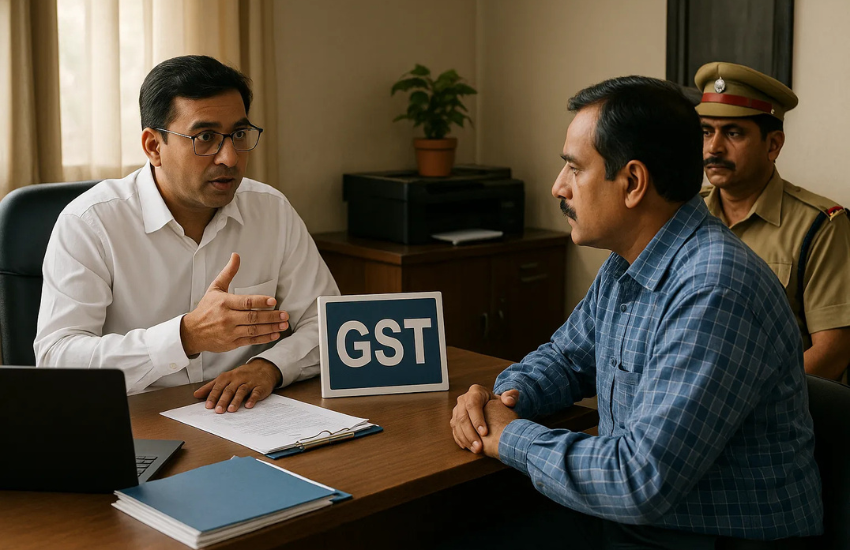
Natural Justice in GST Proceedings: What Every Taxpayer Must Know
By Advocate Mamta Sharma
Natural justice is not a formality—it is the backbone of fair tax administration. And in the GST regime, where automated notices, portal-generated demands, and template orders have become common, the principles of natural justice play a vital, corrective role.
Over the years, while arguing GST matters in High Courts, I have repeatedly seen how violations of natural justice lead to quashing of proceedings entirely. This article explains, in simple but authoritative terms, what natural justice means under GST, what rights taxpayers have, and when courts intervene.
- What Is Natural Justice in GST?
Natural justice under GST essentially means:
(a) The right to be heard (audi alteram partem)
You must be given:
- notice of the case against you,
- clear allegations with specific facts,
- reasonable opportunity to respond, and
- a meaningful personal hearing.
(b) The right to an unbiased, competent officer (nemo judex in causa sua)
The officer:
- must be a proper officer under law,
- must apply independent mind,
- cannot act mechanically on system-generated alerts.
Courts repeatedly emphasize that tax proceedings must be fair, transparent, and reasoned, not automatic.
- Where Natural Justice Is Most Often Violated in GST Proceedings
From experience, I can say that violations arise at multiple stages—often unintentionally due to portal limitations or clerical processes.
Below are the most common grounds on which courts strike down proceedings:
- Vague SCNs Without Proper Allegations
One of the biggest issues today is issuance of template-based notices that lack:
- specific facts,
- detailed calculations,
- relied-upon documents,
- nature of the alleged violation.
Such notices prevent taxpayers from giving a meaningful reply. High Courts have repeatedly held that vagueness goes to the root of natural justice.
- Non-Supply of Relied-Upon Documents
A taxpayer cannot be asked to defend allegations without:
- audit objections,
- statements,
- 2A/2B mismatch worksheets,
- verification records,
- third-party reports.
Failure to supply these materials has been held fatal to the proceedings.
- Denial of Reasonable Opportunity of Hearing
Violations include:
- fixing hearing on very short notice,
- refusing additional time despite request,
- conducting hearing only on the portal without audio/video facility,
- passing the order before the hearing date.
Courts have held that “opportunity of hearing” cannot be symbolic—it must be effective.
- Non-Speaking Orders / Mechanical Orders
A valid GST order must contain:
- discussion of facts,
- evaluation of reply,
- reasoning,
- independent findings.
Orders that:
- simply reproduce the SCN,
- ignore the taxpayer’s defence,
- rely only on portal analytics,
are quashed as violative of natural justice.
- Proceedings by a Non-Jurisdictional or Non-Proper Officer
An officer acting without proper legal authority results in:
- invalid SCN,
- invalid adjudication,
- complete violation of natural justice.
This includes:
- wrong jurisdiction,
- lack of cross-empowerment,
- DGGI and State issuing parallel notices for same period.
- Portal-Driven Proceedings Without Human Application of Mind
This is a frequent problem post-GST.
Examples include:
- 2A/2B mismatch notices auto-generated,
- system-driven “alert notices”,
- automatic blocking of ITC,
- summary orders uploaded without any reasoning.
Courts have held that automation cannot replace adjudication.
- Clubbing of Multiple Notices / Collective SCNs
Authorities often issue one consolidated SCN to:
- multiple branches,
- head office + units,
- related entities.
This is against the GST structure and violates natural justice because each registration is a distinct person under the Act.
- How Courts Protect Taxpayers
Courts intervene whenever the process is unfair. The relief generally includes:
✔ Quashing of SCN and order completely
Most common where the notice is vague or jurisdictionally defective.
✔ Remand with directions to follow due process
Where the issue is procedural, not substantive.
✔ Interim protection / stay against coercive action
Especially in Section 74 notices involving allegations of fraud.
✔ Directions to grant personal hearing
Even where statute does not explicitly mandate it, courts uphold fairness.
✔ Striking down of portal-driven actions
Especially Rule 86A blocking, bank attachment, and DRC-01A issues.
In several of my matters, courts have recognised that natural justice is not optional—it is inherent in every quasi-judicial function.
- Taxpayer Rights You Must Always Assert
Every taxpayer under GST has the following non-negotiable rights:
✔ A clear, specific SCN
Not a template or pasted notice.
✔ Copy of every document relied upon
✔ Reasonable time to respond
✔ Right to personal hearing
✔ Adjudication by a proper officer
✔ A speaking, reasoned order
✔ Protection from arbitrary coercive action
If any of these rights are denied, the entire proceeding becomes vulnerable.
- Practical Advice from Experience in GST Litigation
Here are some insights from handling Section 73/74 matters:
(1) Always demand relied-upon documents in writing.
If they are not given, the proceeding becomes legally defective.
(2) Request a personal hearing—even if the portal does not show the option.
Courts take such procedural lapses seriously.
(3) Challenge vague SCNs immediately through writ petitions.
Do not wait for the final order.
(4) If multiple authorities issue parallel proceedings, challenge on jurisdiction.
(5) Keep complete compliance records as courts appreciate well-documented defence.
(6) Never ignore a DRC-01A.
Your reply becomes part of the record to show cooperation.
Conclusion
GST is a law built on self-assessment, and natural justice acts as the guardrail ensuring fairness. When authorities bypass due process—whether because of digital systems, administrative pressure, or template-based notices—courts step in to protect taxpayers.
Understanding and asserting these rights can make the difference between a lawful assessment and an unlawful demand.