
By Mamta Sharma, Advocate on Record, Supreme Court of India
POSTED IN CRIMINAL LAW
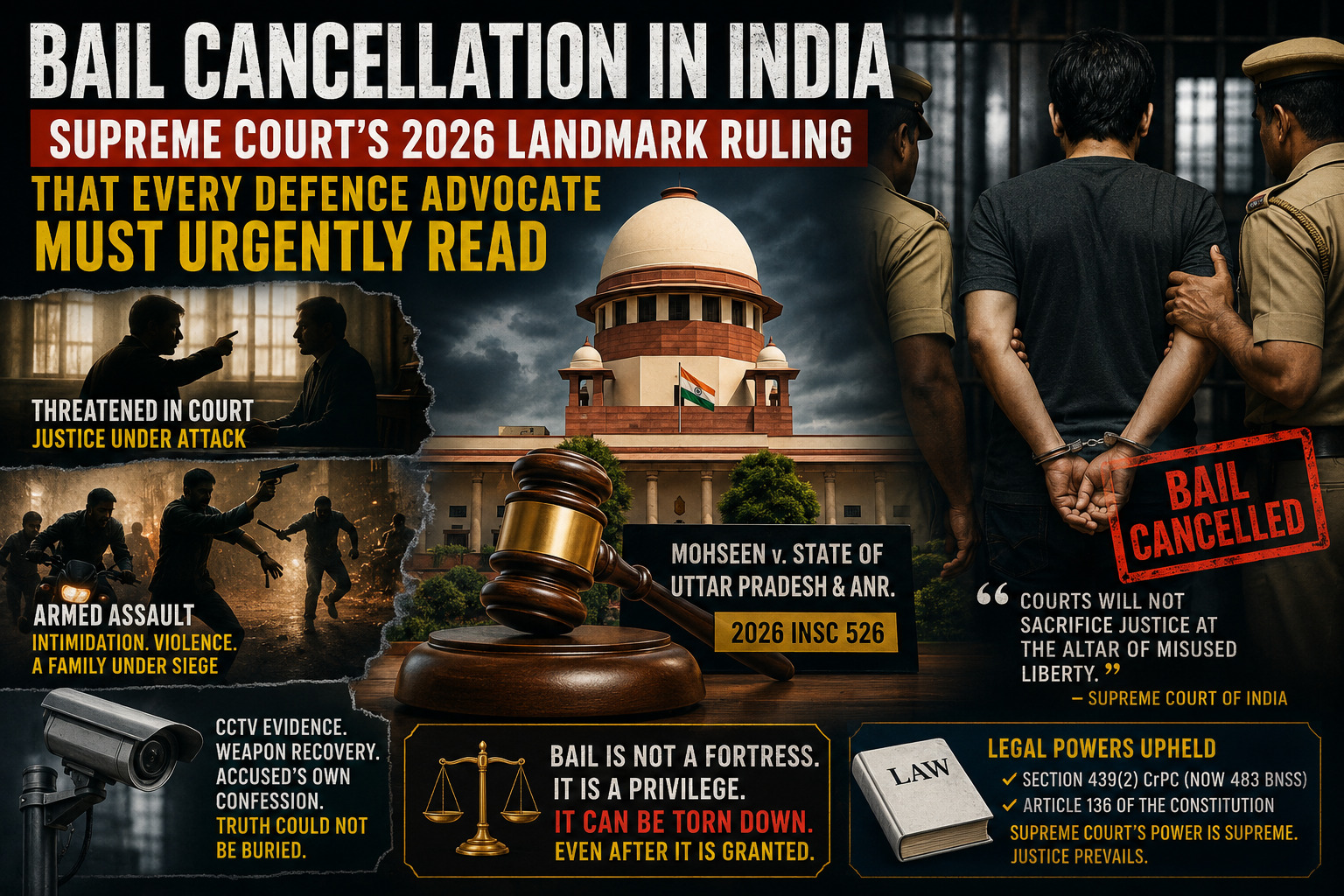
Bail Cancellation India: The Supreme Court’s 2026 Landmark Ruling That Every Defence Advocate Must Urgently Read
Bail cancellation in India is one of the most harrowing legal realities that an accused person and their family can ever face. Most people assume that once a court grants bail, the battle is over. They believe that freedom, once restored, is permanently secure. However, the Supreme Court of India has repeatedly — and powerfully — demolished this dangerous myth.
On 22nd May 2026, the Supreme Court delivered a landmark ruling in Mohseen v. State of Uttar Pradesh & Anr., 2026 INSC 526. This gripping judgment sent a thunderous message across every courtroom in India: bail is not a fortress. It is a privilege. And it can be torn down — even after it is granted.
Furthermore, this explosive ruling carries urgent lessons not just for accused persons, but for victims, witnesses, practising advocates, and every person who has ever feared that the justice system was silently failing them.
What Is Bail Cancellation in India? Understanding the Shocking Truth
Before examining the devastating facts of this case, it is essential to understand what bail cancellation in India actually means — and why it strikes genuine terror into the hearts of those who believed they were safe.
Bail is a legal mechanism that allows an accused person to remain free while their criminal trial continues. It is governed primarily by Sections 437, 438, and 439 of the Code of Criminal Procedure, 1973 — now substantially re-enacted under Sections 478, 479, 480, 482, 483, and 484 of the Bharatiya Nagarik Suraksha Sanhita, 2023 (BNSS). However, bail is not absolute. It is conditional. Courts grant bail based on specific circumstances existing at a particular point in time.
When those circumstances change — or when the accused betrays the trust placed in them — courts possess the formidable power to cancel bail entirely under Section 439(2) CrPC (now Section 483 BNSS). Moreover, the Supreme Court of India holds concurrent and overriding power to cancel bail under Article 136 of the Constitution of India — a power it exercised with decisive force in this very case.
Therefore, bail cancellation in India means that a previously freed accused is ordered back into custody. They must surrender. They lose their freedom again. And as this shattering 2026 Supreme Court ruling proves, even a High Court’s bail order offers no protection when the Supreme Court decides to act.
The Harrowing Story Behind This Case: A Family Under Siege
To truly understand the magnitude of this ruling, you must first understand the heartbreaking human story that ignited it. This is not merely a legal dispute. It is a story of grief, courage, relentless intimidation, and ultimately — the triumphant reassertion of justice.
A Brother Murdered — And a Courageous Family Targeted
The Appellant, Mohseen, had already endured the unimaginable. His brother Aamir was brutally murdered in Meerut, Uttar Pradesh. The accused in that murder — Aabaad and Aurangzeb — were subsequently convicted on 12th November 2025 and sentenced to life imprisonment under Section 302 of the Indian Penal Code, 1860. They were also separately convicted under the Uttar Pradesh Gangsters and Anti-Social Activities (Prevention) Act, 1986 on 1st November 2025.
Mohseen and his family stood as eyewitnesses and victims in those murder proceedings. Consequently, they became targets of a ruthless, premeditated campaign of intimidation designed to silence them permanently.
Threatened Inside a Courtroom — The Ultimate Betrayal of Justice
On 27th February 2024, while Mohseen was attending the murder case proceedings before the Trial Court at Meerut, the accused men threatened him inside the court premises itself — in retaliation for his courageous refusal to compromise or withdraw. This spine-chilling episode of intimidation, committed in the very place designed to deliver justice, resulted in a separate FIR under Section 506 of the IPC at Police Station Civil Lines, District Meerut.
However, the terror did not stop there. It escalated dramatically, violently, and with devastating consequences.
The Armed Assault: Pistols, Pursuit, and Panic on the Streets of Meerut
On 12th May 2024, at approximately 4:30 PM, Mohseen’s uncle Rihan and cousin Afsar were returning home from a neighbouring village. The accused persons — including Jeeshan (Respondent No. 2) — intercepted them on the road. Armed with lathis, a danda, a knife, and a country-made pistol, they savagely attacked the victims. They demanded that the family withdraw the murder case. When the victims fled towards their home, the accused pursued them, forcibly entered the premises, and continued the brutal assault inside.
The CCTV footage from cameras installed near the location captured something devastating. It showed Jeeshan arriving on a motorcycle, entering his house, retrieving a country-made pistol, brandishing it aggressively on the road, climbing to the rooftop of an adjacent house, and firing multiple rounds. Four eyewitnesses — Saheba, Adil, Afsar, and the victim Rihan himself — categorically confirmed what the camera had already recorded.
Moreover, in his own statement to the Investigating Officer, Jeeshan admitted to firing the weapon. He admitted to collecting the spent cartridges to destroy evidence, and concealing the pistol beneath a brick in a ruined building upon learning of the police’s imminent arrival. A .315 bore pistol in working condition and a live cartridge were subsequently recovered at his instance. Accordingly, offences under Sections 3, 25, and 27 of the Arms Act, 1959 were added against him.
The FIR registered was No. 179/2024 at Police Station Partapur, District Meerut, under Sections 147, 148, 149, 323, 324, 452, 504, 506, and 307 of the IPC read with Sections 3, 25, and 27 of the Arms Act, 1959.
The Explosive Legal Battle: A Chronology of Bail, Defiance, and Supreme Court Authority
Stage 1 — Anticipatory Bail Rejected
After the incident, Jeeshan applied for anticipatory bail before the Allahabad High Court in Criminal Misc. Anticipatory Bail Application No. 6855 of 2024. The Single Judge, vide order dated 11th September 2024, rejected the application, expressly finding that a prima facie case of the offence was established and that no extraordinary circumstances had been demonstrated warranting the protection of liberty.
Stage 2 — The High Court’s First Grave and Shocking Error
After his arrest, Jeeshan filed a regular bail application. On 23rd October 2024, the Allahabad High Court granted him bail — shockingly characterising his specific, evidenced role in the crime as merely “vague and general.” This staggering characterisation flew directly in the face of the CCTV footage, four eyewitness accounts, and Jeeshan’s own written admission to the Investigating Officer.
Stage 3 — The Supreme Court Cancels Bail
Mohseen challenged this order immediately before the Supreme Court in SLP (Crl.) No. 18256/2024. On 27th January 2025, the Supreme Court cancelled Jeeshan’s bail in a decisive speaking order. The Court found that the High Court had committed a grave error — that it had erroneously characterised Jeeshan’s role as vague and general, and had completely failed to consider the findings of the Trial Court that had originally rejected his bail application. Jeeshan was directed to surrender forthwith.
Stage 4 — 42 Days of Breathtaking Defiance
What happened next was breathtaking in its sheer audacity. Jeeshan did not surrender. For 42 agonising days, he defied the Supreme Court’s direct order. The Trial Court issued a Non-Bailable Warrant on 10th February 2025. Police raids were conducted at his residence and other likely locations. Proclamation proceedings under Section 82 of the CrPC, 1973 (now Section 84 BNSS) were initiated on 28th February 2025. Still, Jeeshan continued to evade arrest with calculated determination.
He finally surrendered on 10th March 2025 — six torturous weeks after the Supreme Court had commanded him to do so immediately.
Stage 5 — Trial Court Wisely Rejects Fresh Bail
After surrendering, Jeeshan applied for bail before the Trial Court. On 19th May 2025, the Trial Court rejected his application, specifically noting that no new grounds had been raised and that — given the serious nature of the offences, the evidence on record, and his prior conduct — there was a real likelihood of the accused absconding and tampering with evidence if released.
Stage 6 — The High Court Repeats Its Fatal and Inexcusable Mistake
Undeterred, Jeeshan approached the Allahabad High Court once more in Criminal Misc. Bail Application No. 18594 of 2025. On 22nd September 2025, the High Court granted bail — again. This time, it relied on three breathtakingly flimsy grounds:
- A delay of seven hours in lodging the FIR
- The absence of firearm injuries sustained by the victims
- The fact that co-accused Aurangzeb had been released on bail by a coordinate bench
The High Court said nothing about the Supreme Court’s cancellation order of 27th January 2025. It said nothing about Jeeshan’s 42-day defiance. It said nothing about the CCTV footage, the weapon recovery, the Investigating Officer’s report, or Jeeshan’s own confession. As the Supreme Court would subsequently find, this order was perverse, unreasoned, and constitutionally unacceptable — a textbook example of what the Court in Mahipal v. Rajesh Kumar, (2020) 2 SCC 118 had condemned as an order that fails to engage with the material on record.
The Supreme Court Strikes Back: Four Powerful and Transformative Legal Principles
On 22nd May 2026, Justices Sanjay Karol and Nongmeikapam Kotiswar Singh set aside Jeeshan’s bail in emphatic, unequivocal terms. Their ruling in 2026 INSC 526 rests on four devastating legal pillars that will reshape bail cancellation jurisprudence across India for years to come.
Legal Principle 1 — A Superior Court’s Order Cannot Be Silently Ignored
The Supreme Court declared with crystalline clarity that when a High Court grants bail after the Supreme Court has cancelled it, the High Court must substantively engage with the earlier order. It must identify precisely what has changed. It must provide clear, cogent, and persuasive reasons explaining why a departure from the Supreme Court’s considered position is justified.
Silence is not an option. Ignoring the Supreme Court’s order is not an exercise of judicial independence — it is an act of judicial negligence. The Court held:
“While there is no absolute bar against a High Court granting bail to an accused whose bail was previously cancelled by this Court, the grant of bail must be supported by reasons demonstrating either a change in circumstances or the existence of fresh grounds not considered by this Court at the time of cancellation.”
This principle is transformative and immediately actionable. Therefore, any accused person seeking bail after a Supreme Court cancellation must now build a compelling, evidence-based case specifically around supervening changed circumstances — not merely rehearse the arguments that were already considered and rejected.
Legal Principle 2 — A Review Petition Does Not Stay the Original Order
Jeeshan’s advocates argued that his 42-day delay in surrendering was legally justified because he had filed a Review Petition challenging the bail cancellation order. The Supreme Court rejected this argument with emphatic and unambiguous clarity:
“The filing of a Review Petition does not operate as an automatic stay upon the original order. This Court by order dated 27.01.2025 directed immediate surrender, and the Respondent No. 2 was bound to comply with the direction forthwith.”
This is an urgent and practical warning for every litigant and legal practitioner in India. A Review Petition — however sincerely filed — purchases absolutely no automatic protection. Unless the court specifically and explicitly grants a stay, the original order must be obeyed immediately and completely. Non-compliance remains contemptuous and indefensible, regardless of any pending petition.
Legal Principle 3 — Parity in Bail Is Not a Magic Wand
Jeeshan argued strenuously that since co-accused Aurangzeb had been granted bail by a coordinate bench, he was entitled to the same relief on established grounds of parity. The Supreme Court comprehensively demolished this argument on three powerful and independent grounds.
First, the roles of the two accused were fundamentally and materially different. Aurangzeb’s role in FIR No. 179/2024 was primarily that of assault by knife. Jeeshan’s specific, evidenced role was the retrieval of a loaded firearm and the firing of multiple rounds from a rooftop at the victims with the intent to kill. These are not comparable situations.
Second, a .315 bore pistol in working condition and a live cartridge were recovered at Jeeshan’s instance — attracting the additional and serious charges under Sections 3, 25, and 27 of the Arms Act, 1959 that Aurangzeb did not face. This placed his case in an entirely different and more serious legal category.
Third, the SLP challenging Aurangzeb’s bail (SLP (Crl.) No. 16404/2025) was withdrawn after his conviction in the murder case — it was not dismissed on merits and therefore created absolutely no precedent in Jeeshan’s favour.
As the Supreme Court reaffirmed from the authoritative ruling in Neeru Yadav v. State of Uttar Pradesh, (2014) 16 SCC 508: parity cannot be claimed where the accused persons’ roles and the evidence against them are materially different. Parity is a powerful tool of equity — not an escape route for the undeserving.
Legal Principle 4 — Witnesses and Victims Deserve Active Judicial Protection
Perhaps the most emotionally resonant and socially significant dimension of this ruling is its powerful insistence that courts must actively protect witnesses and victims — not merely adjudicate the rights of the accused. This principle strikes at the heart of India’s witness protection challenge.
The Supreme Court drew compellingly on Sudha Singh v. State of Uttar Pradesh & Anr., (2021) 4 SCC 781 to deliver a timeless reminder to all courts:
“There is no doubt that liberty is important, even that of a person charged with crime, but it is important for the courts to recognise the potential threat to the life and liberty of victims and witnesses, if such accused is released on bail.”
Mohseen’s family had already buried a brother. They had been threatened inside a courthouse. They had been intercepted on a public road, chased into their home, and shot at. Releasing their attacker on bail was not a neutral legal act — it was a direct, existential threat to their safety, their mental peace, and their willingness to continue testifying. Therefore, the active protection of witnesses is not merely desirable — it is a constitutional obligation under Article 21 of the Constitution of India that no court can abdicate.
What Section 307 IPC Actually Means — A Crucial Legal Clarification
One of Jeeshan’s most persistent and seemingly logical arguments was that since no one was actually struck by the gunfire, the charge under Section 307 of the Indian Penal Code, 1860 — Attempt to Murder — was not legally established. The Supreme Court rejected this contention with decisive, unambiguous authority.
Section 307 IPC does not require proof of actual physical injury. What it requires is proof of an act done with the intent or knowledge that it is sufficient in the ordinary course of nature to cause death. Therefore, the legal position is clear:
- If an accused retrieves a loaded firearm and fires it at victims with the intent to kill
- And the victims escape by chance — due to misaim, sudden movement, or fortunate circumstance
- The offence under Section 307 IPC is fully and completely established
The absence of bullet wounds was therefore legally irrelevant. The intent was established by the CCTV footage and eyewitness testimony. The act was established by the weapon recovery. The offence was established beyond reasonable argument. This clarification is vital for criminal practitioners handling attempted murder cases across every court in India — from Sessions Courts to the Supreme Court.
The Governing Legal Framework: Cases Relied Upon by the Supreme Court
The Supreme Court’s ruling rests on a powerful and authoritative foundation of precedent. Every practitioner engaged in bail litigation must be intimately familiar with these decisions:
Ajwar v. Waseem & Anr., (2024) 10 SCC 768 — The Court held that an unreasoned or perverse bail order is always open to interference by a superior court, and that bail can be cancelled where courts below have ignored relevant material on record or the gravity of the offence.
Mahipal v. Rajesh Kumar, (2020) 2 SCC 118 — Bail orders must be reasoned orders that engage with the material on record. A mere recitation of “the facts and circumstances of the case” without substantive analysis does not constitute a reasoned order and is liable to be set aside.
Prasanta Kumar Sarkar v. Ashis Chatterjee, (2010) 14 SCC 496 — The Court laid down the comprehensive eight-factor test for assessment of bail applications, covering prima facie case, nature and gravity of accusation, severity of punishment, risk of absconding, character of the accused, likelihood of repetition, risk of witness influence, and danger of justice being thwarted.
Neeru Yadav v. State of Uttar Pradesh, (2014) 16 SCC 508 — Parity in bail is not an inflexible rule and cannot be mechanically applied when the roles of the accused persons are materially different or when one accused is a history-sheeter.
Sudha Singh v. State of Uttar Pradesh & Anr., (2021) 4 SCC 781 — Courts must recognise and actively weigh the potential threat to the life and liberty of victims and witnesses when considering bail applications involving accused persons charged with witness intimidation.
Key Bail Cancellation Principles: Your Urgent Takeaways
To summarise this landmark ruling, here are the most powerful and immediately applicable legal propositions firmly established by the Supreme Court of India in 2026 INSC 526:
1. When bail is cancelled by the Supreme Court, a High Court granting fresh bail must identify changed circumstances or fresh grounds — silence in the face of a superior court’s order is constitutionally impermissible.
2. A pending Review Petition is not a stay order. Non-compliance with a court direction is contemptuous until a specific stay is explicitly granted by a competent court.
3. Post-bail conduct — including deliberate defiance of court orders, absconding, and witness intimidation — is a decisive and weighty factor in all bail proceedings.
4. The principle of parity in bail does not apply where accused persons have materially different roles, evidence, and charges against them.
5. Section 307 IPC is established on intent and the nature of the act — not on whether physical injury actually results from the attempt.
6. Bail orders must be substantively reasoned orders under the eight-factor test in Prasanta Kumar Sarkar — a recitation of “facts and circumstances” without analysis is constitutionally insufficient.
7. The protection of witnesses is a recognised, weighty, and constitutionally mandated ground for refusing or cancelling bail under Article 21 of the Constitution.
What This Means for You: Practical Guidance from The Case Counsel
Whether you are an accused person currently out on bail, a victim living in daily fear, a witness facing ruthless intimidation, or a family member navigating India’s complex criminal justice system — this ruling carries immediate, practical, and life-changing consequences for you.
If you are an accused person out on bail: Comply rigorously with every bail condition. Attend every single court hearing. Never defy a court direction — not even for a single day. Understand that your conduct after bail is granted is now explicitly, rigorously, and mercilessly scrutinised by courts. A single act of defiance can result in permanent bail cancellation.
If you are a victim or witness facing intimidation: Know, with absolute certainty, that India’s courts take witness protection seriously. Document every threat — in writing, with dates, times, and witnesses. Report every incident to the police and place it before the court. Courts now have powerful authority and demonstrated willingness to cancel bail where witnesses and victims face genuine danger.
If your bail has been cancelled: Do not make the catastrophic mistake of simply re-applying on the same grounds before a different court. Build a specific, compelling, evidence-based case around supervening changed circumstances. Engage experienced criminal advocates who understand the evolving and demanding jurisprudence of bail cancellation in India.
At The Case Counsel, we have extensive, hands-on experience in criminal appellate work, bail applications, and bail cancellation proceedings before the Sessions Courts, High Courts, and the Supreme Court of India. Our dedicated team combines deep doctrinal knowledge with strategic, persuasive advocacy — ensuring that your rights, your safety, and your freedom are protected at every critical stage of the proceedings. Contact our advocates today for a confidential consultation.
Conclusion: Justice Cannot Be Intimidated Into Silence
The ruling in Mohseen v. State of Uttar Pradesh & Anr., 2026 INSC 526 is ultimately about something far larger and more profound than one bail order in Meerut. It is about the survival of eyewitness testimony. It is about the integrity of criminal proceedings. It is about whether ordinary, courageous people — who risk everything to tell the truth in a courtroom — can genuinely and completely trust the system to protect them.
Bail cancellation in India is not merely a legal remedy available to aggrieved parties. It is a solemn declaration by the courts that they will not be complicit in the silencing of justice. When an accused person fires at witnesses, defies the Supreme Court for 42 consecutive days, and returns to the High Court as though absolutely nothing happened — the Supreme Court’s answer must be, and emphatically was, unequivocal.
Justice has a long memory. And bail cancellation in India is its most powerful, most fearless proof.
This article is published by The Case Counsel for informational and academic purposes only. It does not constitute legal advice. For specific legal guidance on bail cancellation, bail applications, or criminal appellate matters, contact our advocates directly.
Case Reference: Mohseen v. State of Uttar Pradesh & Anr., 2026 INSC 526, decided 22nd May 2026 by Justice Sanjay Karol and Justice Nongmeikapam Kotiswar Singh, Supreme Court of India.